Electronic Signatures in 2026: What Is Enough, What Isn’t and Where Companies Get Burned
These days you can sign most contracts with a click, through your bank identity or in DocuSign. Then comes a transfer of a business share, a notice of termination to an employee or a dispute over an unpaid invoice, and it turns out that an electronic signature is not just one thing. In this guide, as a Czech attorney, I show you which signature to use for which document under Czech law, what it costs, and how to make sure that in court you hold evidence, not just a PDF.
Legal position as of 7 November 2026.
In brief
- Between businesses, you can validly sign almost anything even with a basic electronic signature. The law expressly allows it and the courts confirm it.
- The level of the signature, however, decides how easily you can prove it in a dispute. The simpler the signature, the more evidence you need in reserve.
- Where the law requires an officially certified signature (for example a transfer of a share in a Czech s.r.o.), a notarial deed, or a signature towards an authority or an employee, a simple click is not enough. Even there, though, a digital route already exists.
Is it even valid? And why does the type of signature matter?
It is. The foundation is the EU eIDAS Regulation (No 910/2014). Under its Article 25, an electronic signature may not be denied legal effect or admissibility as evidence solely because it is electronic or because it is not the “highest” type. The Czech Act on Trust Services (No. 297/2016 Coll.) expressly states in Section 7 that “another type of electronic signature” may also be used in private-law relationships. The Czech Civil Code then adds in Section 562 that the written form is preserved even for an act made electronically, provided its content can be captured and the acting person identified.
A court has confirmed this in practice. In September 2024, the Municipal Court in Prague decided a dispute between two companies over a commission of CZK 960,000 from a real-estate brokerage. One of them claimed that it had never concluded the agreement signed via DocuSign (a link in an email and an SMS code) because it was not an “advanced” signature. The court disagreed: a simple electronic signature is “admissible and valid” for private-law acts (judgment 54 Co 217/2024-259, in Czech). No appeal on a point of law was filed.
For you, though, the second half of that judgment matters more. The court also said that with a simple signature, whoever relies on it must “positively prove” two things: who signed and that they genuinely expressed their will. The company that won the dispute did not succeed thanks to the PDF alone. It succeeded thanks to other evidence, above all how the parties behaved after signing, and thanks to witnesses.
The question usually isn’t whether an electronic signature is valid, but how easily you can prove it.
Under eIDAS, a qualified signature has the same effect as a handwritten one and essentially defends itself. With a simple signature, what defends you is your audit trail, your correspondence and the other party’s conduct.
One fair caveat: this is a decision of an appellate court, which does not formally bind other courts. The Czech Supreme Court has not yet ruled on simple signatures since eIDAS was adopted. And some courts have been stricter, see the section on emails below.
What types of electronic signature are there?
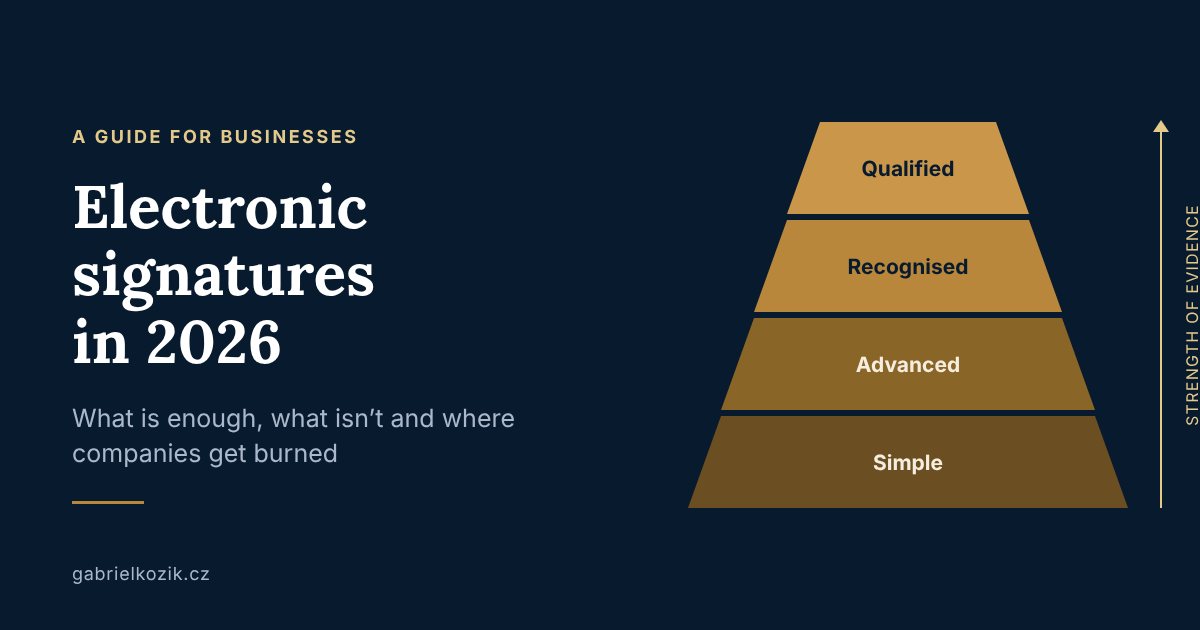
Picture a four-storey pyramid. The higher you go, the stronger the evidence, but also the more paperwork to obtain it. An officially certified signature stands next to the pyramid as a separate category.
| Type | What it looks like | What it does | Where it fits |
|---|---|---|---|
| Simple | click + SMS code, finger signature on a tablet, pasted scan of a signature | valid between companies, but you may have to prove identity and intent with other evidence | NDAs, orders, ordinary contracts |
| Advanced | signature via Bank iD SIGN, company certificate | technically proves who signed and that the document has not been changed since | higher-value contracts, leases |
| Recognised (Czech-only) | advanced signature with a qualified certificate (e.g. from Czech Post or I.CA) | sufficient for authorities and for electronic delivery of notices to employees | executive director dealing with authorities, HR |
| Qualified | certificate on a smart card, token, ID-card chip or remotely in the cloud | same effect as a handwritten signature across the EU | corporate documents, cross-border contracts, land registry |
The “recognised” signature (uznávaný podpis) is a Czech peculiarity (Section 6(2) of Act No. 297/2016 Coll.). Nobody abroad knows it, so with a foreign partner talk only about simple, advanced and qualified signatures.
Besides signatures there is also the electronic seal. It is the equivalent of a company stamp: it proves that a document comes from your company and that nobody has altered it. It suits invoices or bulk-generated documents. It does not, however, replace the executive director’s signature on a contract.
And what about the Czech ID card with a chip? The chip can serve as secure storage for a qualified signature, but you have to buy the certificate from a certification authority and load it onto the chip (guide at identita.gov.cz, in Czech). A free state-issued qualified signature does not exist yet.
“Signed via Bank iD.” What does that actually mean?
This is where most misunderstandings arise. The Czech bank identity (Bank iD) label covers three different things with different legal consequences.
Bank iD as a login. You prove who you are, just as when you log in to internet banking. That is identification, not a signature. If a signing platform verifies you via Bank iD and you then sign with a click, the result is a simple signature, just with a very well verified identity. Excellent as evidence, but the category remains “simple”.
Bank iD SIGN. A free service that anyone with a bank identity can use. It creates an advanced signature, but on a certificate that is not qualified. It is therefore not sufficient for authorities, and Adobe Reader may display it with a yellow warning that “the identity could not be verified”. That does not mean the signature is invalid, only that the reader does not know the certificate issuer. Some media wrongly describe SIGN as a qualified signature.
Bank iD QSIGN. A newer service, on the market since December 2025, so far mainly for mortgages and property transfers. Via your bank identity, a certification authority issues you a qualified certificate and creates the signature remotely. The result is a qualified signature. According to the terms of the service (in Czech), under certain conditions it can also meet the requirement of an officially certified signature. Check with the provider exactly how this works in your specific case before you build a share transfer on it.
| Service | Type of signature | Enough for authorities? |
|---|---|---|
| Bank iD login + click | simple (with verified identity) | no |
| Bank iD SIGN | advanced | no |
| Bank iD QSIGN | qualified | yes |
DocuSign, Signi, DigiSign: which one is the “strongest”?
Wrong question. A platform is not a signature level. The same service can create a simple signature for a few crowns and a qualified signature through a partner certification authority. Before you choose a service, ask mainly three things:
- What type of signature (simple, advanced, qualified) is actually created on my plan?
- How does the service verify the signer’s identity (email, SMS, Bank iD, ID document)?
- Where is the data stored, and do I get an exportable audit trail for every document?
What platforms add on top, and what is often overlooked: they usually attach their own technical signature or seal to the document and keep a record of when who opened and signed it. In a dispute, that is the evidence, not the image of a signature on the last page.
What it costs
Indicative prices from official price lists as of 7 November 2026. Make sure you only compare the same signature levels and the same billing method.
| Service | Price from | Note |
|---|---|---|
| Bank iD SIGN | free | advanced signature, one-off |
| DigiSign | up to 5 signatures a month free; ONE plan CZK 270/month excl. VAT | Czech service, also supports Bank iD SIGN |
| Signi | CZK 38 per document | Czech service, qualified signatures on higher plans |
| youtrust (formerly Yousign) | free (2 signatures a month); One €9/month excl. VAT | French service, prices with annual billing |
| DocuSign | Personal €9/month; Standard €23/user/month | prices with annual billing |
| Skribble | Team €23/user/month excl. VAT (72 advanced or qualified signatures included) | Swiss service, annual billing |
| Adobe Acrobat Pro | €24.19/month incl. VAT | signatures as part of Acrobat |
| PostSignum (Czech Post) | CZK 440/year incl. VAT | qualified certificate, issued at a post office or Czech POINT |
| I.CA | CZK 1,341 incl. VAT | qualified certificate including a smart card |
For a small company that signs dozens of contracts a year, usually with Czech partners, a combination makes sense: a Czech platform with Bank iD verification for ordinary contracts, and one qualified certificate for the executive director for authorities and important documents.
Which signature for which document?
The left column shows the minimum with which the document is valid. The right column shows what I recommend so that you can prove it easily in a possible dispute.
| Document | What is enough | What I recommend |
|---|---|---|
| NDA, ordinary commercial contract | simple signature | platform with an audit trail; for higher amounts, Bank iD verification or a qualified signature |
| Order and its confirmation | simple signature | confirmation via a platform or data box; a bare name under an email is risky |
| General terms and conditions | demonstrable consent | link to the T&Cs + consent tick box in the ordering process |
| Lease agreement | simple signature | Bank iD SIGN or another advanced signature |
| Employment contract, DPP, DPČ (agreements to perform work) | simple signature | advanced signature; the employer must send a copy to the employee’s private email |
| Notice of termination, summary dismissal, termination during probation | employer’s recognised signature + employee’s consent in a separate statement + their private email | employee’s data box |
| Salary or pay statement | recognised e-signature of the person acting for the employer (an electronic seal from the payroll system alone does not replace it); a work email is also enough, but without confirmation of receipt within 15 days, delivery is ineffective | data box or handing over in person |
| General power of attorney | simple signature | advanced signature |
| Power of attorney for an act requiring a certified signature | officially certified signature | paper and certification, e-legalisation, or a recognised signature with a registered certificate (not for a power of attorney for a notarial deed) |
| Transfer of a share in an s.r.o. | officially certified signatures | qualified signature meeting the Czech Digital Services Act, or e-legalisation |
| Real-estate purchase agreement | written form; for entry in the land registry, the authenticity of signatures must be proven | qualified signature (e.g. Bank iD QSIGN), or paper with officially certified signatures |
| Filing with an authority, public procurement | recognised signature | data box |
| Invoice | authenticity and integrity of the document | PDF from the accounting system; an electronic seal is not mandatory |
If you are unsure, a simple rule applies: the higher the amount, the less you trust the other party, and the more the document concerns the state, employees or shares in a company, the higher up the pyramid you should go.
When is a basic electronic signature not enough?
There are not many exceptions, but they tend to be expensive. Here are the ones businesses run into most often.
Officially certified signature. Typically a contract for the transfer of a share in an s.r.o. (Section 209(2) of the Business Corporations Act), powers of attorney for such acts, or certain contracts between a single-member s.r.o. and its member. No electronic signature on its own replaces an officially certified one. Since 2022, however, the Digital Services Act (No. 12/2020 Coll.) has offered two digital routes. The first is a qualified or recognised signature where it can be verified, via the population register or via the ID-document data in the certificate, that the certificate belongs to you. You register the certificate on the Citizen Portal (in Czech). The second route is e-legalisation: a notary, an attorney or Czech POINT certifies your electronic signature much like one on paper.
Official certification can also be replaced by an attorney’s declaration of signature authenticity (Section 25a of the Czech Legal Profession Act). You sign in front of an attorney, or acknowledge your electronic signature as your own in front of them, and the declaration has the same effect as certification. If an attorney is drafting your contract anyway, this is usually the simplest route: signing and certification are dealt with in a single meeting.
Watch out for the power of attorney. It must have the same form as the act itself (Section 441(2) of the Civil Code), so for a share transfer an officially certified signature or its digital equivalent. And the medium must match too: you cannot simply print an electronic power of attorney and attach it to a paper contract, because the printout carries no signature. You need an authorised conversion (Czech POINT, a notary, an attorney), and the same applies the other way round. Where the law requires a notarial deed, for example when setting up an s.r.o., a power of attorney signed even with a registered certificate is not enough (Section 6(3) of Act No. 12/2020 Coll.). That leaves paper with certification or e-legalisation.
Notarial deed. Setting up an s.r.o., changes to the memorandum of association and similar acts. Even here you can act remotely: since 2021, the Notarial Code has allowed a remote notarial deed via video conference with electronic identification (Section 64a of the Notarial Code).
Real estate and the land registry. A real-estate purchase agreement must be in writing (Section 560 of the Civil Code). For the land registry to record it, however, you must prove the authenticity of the signatures (Section 7 of the Cadastral Act). On paper this is usually done by officially certifying the signatures or by an attorney’s declaration of signature authenticity. An electronic contract must be signed with a recognised or qualified signature, and authenticity is proven in the ways set out in the cadastral decree. In practice, Bank iD QSIGN can do this today, for example with a mortgage through a bank. A basic signature from a signing platform is not enough for the land registry.
Authorities. Anyone filing electronically with an authority needs a recognised signature (Section 6 of Act No. 297/2016 Coll.). For a company, though, a data box (datová schránka) is usually simpler: a filing sent from it has the same effect as a signed document. Note that it does not replace an officially certified signature.
Employees. You can sign an employment contract or agreement electronically without special requirements. The employee may, however, withdraw from an electronically concluded contract within 7 days of receiving the copy, unless they have already started work (Section 21 of the Labour Code). For a notice of termination, summary dismissal or termination during probation, the rules are strict: you may deliver them by email only with the employee’s consent in a separate written statement, to an address you have no access to, and signed with a recognised electronic signature (Section 335 of the Labour Code). If the employee does not confirm receipt, the document is deemed delivered on the 15th day after it arrived. A salary or pay statement has an exception (Section 335(3)): you do not need the employee’s consent and can also send it to a work email. The recognised signature still applies here, though, and watch out for the opposite consequence: if the employee does not confirm receipt within 15 days of sending, delivery is ineffective. Online you will also find claims that the 2025 “flexi-amendment” to the Labour Code abolished this requirement. It did not. The safer route is the employee’s data box, if they have one.
How do you safeguard a signature for a possible dispute?
A signature dispute is usually won not by whoever had the “better” signature, but by whoever had better evidence. This checklist takes a few minutes to set up and will save you a lot of stress when the other party starts pretending it never signed anything.
- For every signed document, download and keep the audit trail (who, when, from which address and how they were verified). Don’t rely on the platform still having it in five years.
- For higher-value contracts or a new partner, use identity verification via Bank iD, not just email and SMS.
- Check that an authorised person is signing for the company. A signature proves who signed, not whether they were allowed to act. Look in the Commercial Register to see whether two executive directors must sign jointly.
- Archive the original signed file, not a printout or screenshot. A printed PDF no longer carries any electronic signature.
- For documents you will need for years (open-ended contracts, share agreements), deal with long-term verifiability: certificates expire after 1–3 years, and a qualified time stamp helps.
- Agree in the contract how it may be amended, and be specific. A clause saying “amendments only in writing” is not enough: a simple electronic signature also meets the written form (Section 562 of the Civil Code). State expressly, for example, “only by an amendment signed by hand or with a qualified electronic signature” (Section 564 of the Civil Code).
- Don’t sign one document half on paper and half electronically. You end up with two different “originals”.
- Before you click on a “Sign the document” request, check the sender and the domain. Fake signing requests are a popular form of phishing.
Which myths do I hear most often?
“A name under an email is a signature, so I can conclude anything by email.” Even the courts disagree on this. The Municipal Court in Prague listed a name at the end of an email among examples of a simple signature, while the High Court in Prague said in 2023 that a mere name in the text of an email cannot be considered an electronic signature (case no. 4 Cmo 52/2023, according to an article on epravo.cz, in Czech). For small orders it is usually enough; for anything involving money or the written form, it is not.
“DocuSign is always a qualified signature.” It is not. A standard signature in DocuSign and similar platforms is simple. It is qualified only where you expressly choose and pay for it.
“Bank iD SIGN is a qualified signature.” It is not; it is an advanced signature. A qualified signature via bank identity is offered by the QSIGN service.
“A pasted image of my signature is an electronic signature, so it is the same as a handwritten one.” It is a simple signature, the weakest option. Anyone can copy it into another document. It may be valid, but proving it will be very hard.
“A data box message means a signed contract.” A message from a data box has the effect of a signed document towards authorities. Between companies it is very strong evidence of who sent what and when, but it is not an automatic signature of a contract.
“I can just email a notice of termination to an employee.” Only if you meet the conditions of Section 335 of the Labour Code, including a recognised signature. Otherwise you risk the notice not being validly delivered.
“We’ll sign the share transfer in an app.” Not without officially certified signatures or their digital equivalent under the Digital Services Act. An ordinary signing platform is not enough for that.
“The yellow warning in Adobe means the signature is invalid.” Usually it only means that the reader does not know the certificate issuer. You can check the validity of a signature, for example, in the European DSS validator.
What will change with the European Digital Identity Wallet?
The revision of the eIDAS Regulation (Regulation 2024/1183, known as eIDAS 2.0) requires every Member State to offer its citizens a European Digital Identity Wallet by 21 November 2026 (timeline at archi.gov.cz, in Czech). It will be a mobile app holding your documents, from which you will also be able to sign with a qualified signature.
The Czech Republic will miss the deadline. The amendment that is to introduce the wallet sits in the Chamber of Deputies as print no. 154 and, as of 7 November 2026, had not even passed its first reading.
Two things are worth knowing already:
- A qualified signature from the wallet is to be free only for natural persons for non-professional purposes. For signing in the course of business, you may not be entitled to a free signature.
- Selected private companies (banks, telecoms, transport, healthcare) will eventually have to accept the wallet for identity verification. For an ordinary business, this does not change the rules for signing contracts.
Practical takeaway: don’t wait for the wallet, and don’t buy anything today for five years ahead. An annual certificate and a signing platform on a monthly plan keep your options open.
Frequently asked questions
Do both parties have to sign with the same type of signature?
Is a DocuSign signature valid in court?
Can I, as an executive director, sign for the company via Bank iD?
Is a scan of a signed contract sent by email valid?
Do I need a qualified certificate as a sole trader or small company?
I’m signing with a foreign company. What should I use?
What to take away?
Today, an electronic signature is not a question of “whether” but of “which one”. For everyday business, a sensibly chosen platform with a good audit trail is enough. For share transfers, real estate, authorities and employees, it pays to go higher up the pyramid, or at least to ask before you sign.
Setting up signing in your company, or dealing with a specific contract or a signature dispute? I’ll be glad to take a look. The first 30 minutes of a consultation are free and in plain language.
Book a consultationI’m also interested in your experience: what do you use to sign today, and has the other party ever disputed your signature?
This article is general information as of 7 November 2026, not legal advice on a specific case. Service prices may change; always check them with the provider.
Sources and further reading (mostly in Czech):
- Judgment of the Municipal Court in Prague 54 Co 217/2024-259 of 10 September 2024
- Labour Code, delivery of documents (Sections 334–337)
- Bank iD QSIGN terms of service
- Electronic signing with a Czech ID card
- Registering a qualified certificate in the population register
- European Digital Identity Wallet – timeline
- Chamber of Deputies print no. 154 – legislative progress
- M. Peškar: Digitalisation of HR after the amendment – is it really that easy?
- Regulation (EU) No 910/2014 (eIDAS) as amended by Regulation (EU) 2024/1183; Act No. 297/2016 Coll.; Act No. 12/2020 Coll.; Act No. 85/1996 Coll., on the Legal Profession; Act No. 89/2012 Coll., Civil Code; Act No. 90/2012 Coll., on Business Corporations; Act No. 262/2006 Coll., Labour Code